My Friend Asked Me How to Invest $100. I Told Him Something That Sounds Insane.
My Friend Asked Me How to Invest $100. I Told Him Something That Sounds Insane.
This is a public experiment. I might be right. I might be wrong. Either way, it will happen in the open.
Raj texted me last week.
"I have $100 I want to invest. What should I buy?"
I told him I would put $100 into a DeFi token called RISE and let it compete against every major asset class — simultaneously, in public, with live prices — for as long as it takes to know whether I was right or wrong.
"That's insane," Raj said.
"Yes," I said. "That's the point."
The Public Experiment
I am not asking you to trust me. I am not asking you to invest. I am asking you to watch.
On April 26 and 27, 2026, I put $100 into RISE Token and $100 into each of 24 other assets — the S&P 500, Bitcoin, Apple, Gold, Tesla, Ethereum, and 18 more. The live scoreboard is on the homepage of this site, updated on every page refresh.
I could lose the entire $100. That is a real possibility and I am not pretending otherwise. The worst case is that I lose $100 publicly, and you get to watch it happen in real time. The best case is that the math I am about to explain turns out to be correct, and RISE outperforms every benchmark I could find.
There is no middle ground. This is not a hedge. This is a bet on a specific mathematical claim, made in public, with a permanent on-chain record.
What RISE Actually Is
RISE is not a meme coin. It is not a governance token. It is not a stablecoin. It is a mathematical amplifier built on top of a deflationary locking mechanism.
Here is the mechanism. The FLAT Protocol runs a treasury. That treasury earns revenue from trading fees and protocol activity. Every 12 seconds, an autonomous function called pulse() fires. It takes the accumulated revenue, buys RISE tokens on the open market, and permanently locks them in a vault. The locked RISE is never sold. It accumulates forever. The vault's RISE balance only ever goes up.
This is the critical point: retail buyers of RISE do not fund the vault. The protocol itself funds the vault through its own arbitrage engine. When you buy RISE on Uniswap, you are buying into a system where an autonomous treasury is continuously removing RISE from circulation on your behalf — not because of any promise or governance vote, but because the code runs every 12 seconds and cannot be stopped.
RISE is a claim on that vault. When you buy RISE, you are buying a proportional share of a pool of permanently locked RISE tokens. The amplification works because the vault's RISE balance grows with every pulse() cycle, but the RISE supply does not grow at the same rate. The math creates structural upward pressure on RISE's price.
The key parameter is α = 0.999882. This is the absorption ratio — the fraction of all RISE that has been permanently locked. It is not a variable. It is not a governance parameter that can be changed by a vote. It is baked into the contract.
As of April 27, 2026, 424.95 million RISE tokens are permanently locked in the vault. That number will never decrease.
The Singularity Equation
The price of RISE is governed by a single equation:
P(α) = C / (1 − α)
Where α is the absorption ratio and C is a constant determined by the initial conditions.
At α = 0, price equals C. At α = 0.5, price is 2C. At α = 0.9, price is 10C. At α = 0.99, price is 100C. At α = 0.999, price is 1,000C. As α approaches 1, price approaches infinity.
This is not a projection. It is a mathematical identity. The floating supply of RISE shrinks as tokens get locked. A fixed amount of buy pressure against a shrinking supply produces a higher price. The equation is the consequence of that arithmetic.
The key insight is that infinite price does not require infinite money. In a normal market, doubling the price of an asset requires roughly doubling the capital invested. But in the Singularity Equation, as α approaches 1, the circulating supply approaches zero at the same rate that price approaches infinity. The product of price and circulating supply — the circulating market cap — remains constant. The pool does not need more liquidity to support higher prices. The math handles it.
FLAT Protocol launched RISE at α = 0.999882. Out of 425,000,000 RISE tokens, 424,950,000 were locked at genesis. The floating supply is approximately 50,000 RISE — 0.0118% of total. The singularity multiplier at this absorption level is approximately 8,500x.
The Self-Reinforcing Loop
Here is why this matters beyond the equation.
Every time RISE is traded on Uniswap, the pool generates fees. Those fees flow into the FLAT Protocol treasury. Every 12 seconds, pulse() takes that treasury balance, buys RISE, and locks it permanently. This reduces the floating supply. A smaller floating supply means each subsequent trade has more price impact. More price impact means more volatility. More volatility means more trading. More trading means more fees. More fees means more pulse() cycles. More pulse() cycles means more locking.
The loop is self-reinforcing. It does not require external capital injection. It runs on its own trading volume.
The Two Transactions
Purchase 1 — April 26, 2026 at 09:39 UTC
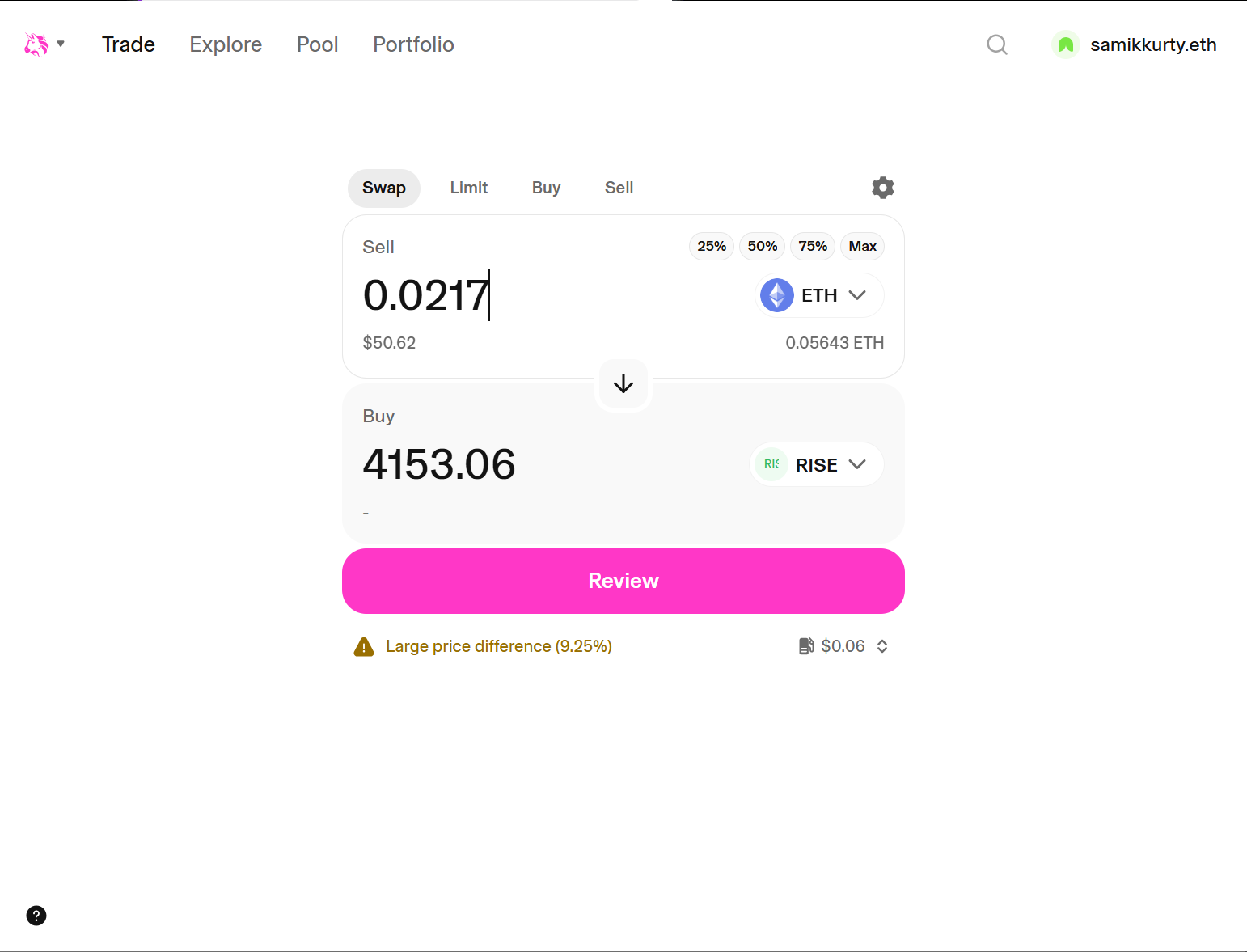
I swapped 0.0217 ETH ($50.62) for 4,153.0553194 RISE tokens on Uniswap V3. The transaction is permanently recorded on the Ethereum blockchain.
Transaction hash: 0x6c5ef55338adc34bf6a44b9b7436fffd0de92c66ef8a14ca2f06a993adf0f95e
Entry price: $0.012189 per RISE token. Wallet: samikkurty.eth.
Purchase 2 — April 27, 2026
I swapped 0.0216 ETH ($50.23) for 3,181.5095 RISE tokens on Uniswap.
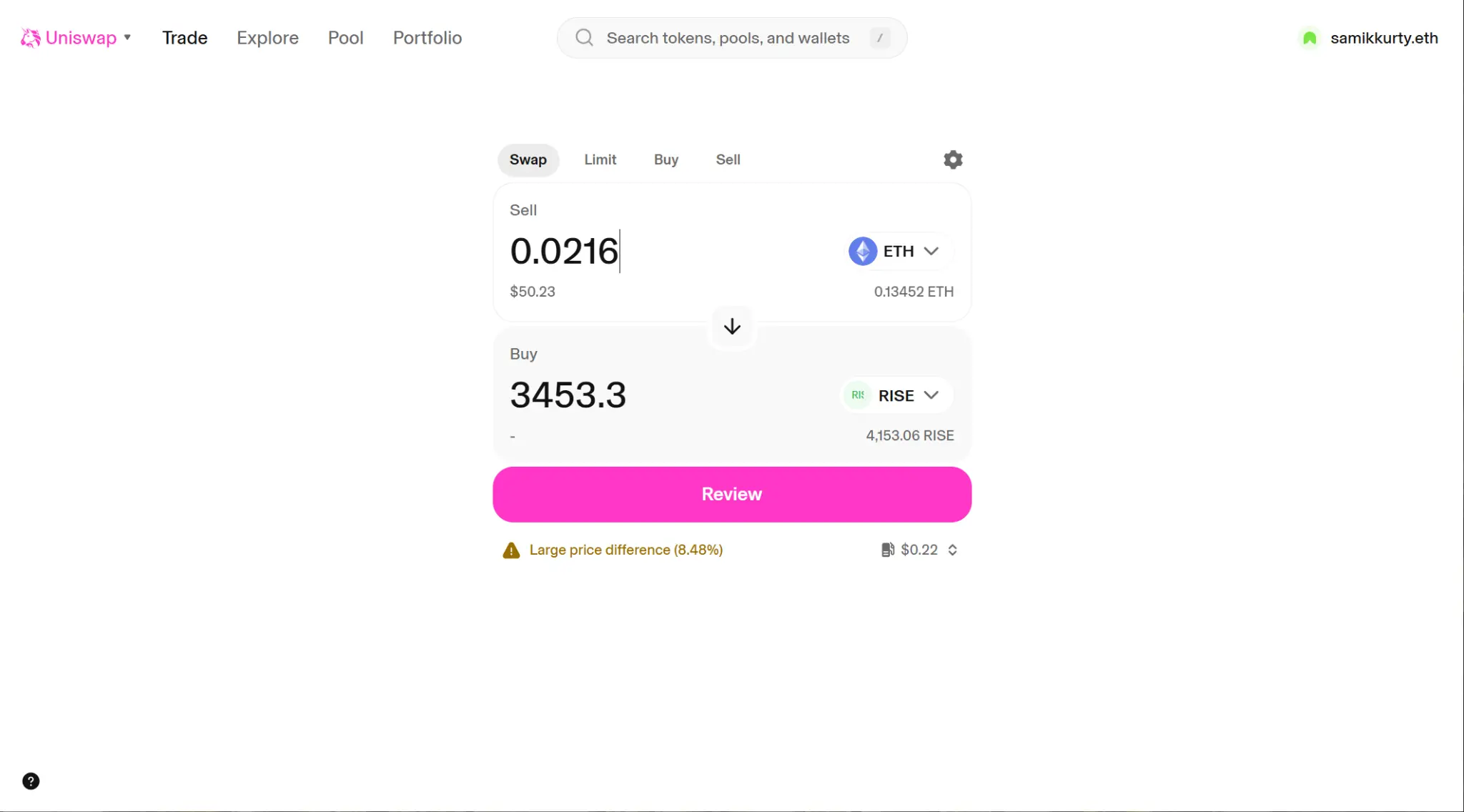
Transaction hash: 0xc3a60bdd8bb063b10f017253b312e1c0a903c4c630eecc704ed82994095b0695
Total RISE held: 7,334.5648 tokens. Blended entry price: $0.013634 per token. Wallet: samikkurty.eth.
Uniswap Pool: 0x2cC90956C7bB5B1b7644CbaBdf031Fdd883216d5
Buy RISE: app.uniswap.org ↗
The 25-Asset Scoreboard
Here is what I bought simultaneously on April 26–27, 2026 — $100 in each of 25 assets:
| Asset | Ticker | Class | Day 0 Price | Qty for $100 |
|---|---|---|---|---|
| RISE Token | RISE | DeFi | $0.013634 | 7,334.5648 tokens |
| NVIDIA | NVDA | Mag 7 | $208.27 | 0.4803 shares |
| Apple | AAPL | Mag 7 | $271.06 | 0.3689 shares |
| Microsoft | MSFT | Mag 7 | $424.61 | 0.2355 shares |
| Amazon | AMZN | Mag 7 | $263.99 | 0.3788 shares |
| GOOGL | Mag 7 | $343.36 | 0.2913 shares | |
| Meta | META | Mag 7 | $675.04 | 0.1481 shares |
| Tesla | TSLA | Mag 7 | $376.33 | 0.2657 shares |
| Berkshire Hathaway | BRK-B | Blue Chip | $469.32 | 0.2131 shares |
| JPMorgan Chase | JPM | Blue Chip | $308.28 | 0.3244 shares |
| S&P 500 | SPY | Index | $713.67 | 0.1401 shares |
| Nasdaq 100 | QQQ | Index | $663.95 | 0.1506 shares |
| Dow Jones | DIA | Index | $492.21 | 0.2032 shares |
| Bitcoin | BTC | Crypto | $77,905.50 | 0.001284 BTC |
| Ethereum | ETH | Crypto | $2,328.61 | 0.04294 ETH |
| Solana | SOL | Crypto | $86.23 | 1.1595 SOL |
| Coinbase | COIN | Crypto | $199.77 | 0.5005 shares |
| Gold | GLD | Commodity | $433.25 | 0.2308 shares |
| Silver | SLV | Commodity | $68.79 | 1.4537 shares |
| Crude Oil | USO | Commodity | $132.40 | 0.7557 shares |
| US Treasury 20Y+ | TLT | Bond | $86.71 | 1.1533 shares |
| High-Yield Corp Bonds | HYG | Bond | $80.48 | 1.2425 shares |
| US Real Estate | VNQ | Real Estate | $95.30 | 1.0493 shares |
| Global Real Estate | VNQI | Real Estate | $46.96 | 2.1295 shares |
| US Dollar Index | UUP | Currency | $27.48 | 3.6390 shares |
| Savings Account | — | Cash | 4.50% APY | $100.00 |
The live scoreboard — updated on every page refresh — is on the homepage.
The Objections
Raj had three objections. They are the same three objections everyone has.
Objection 1: "This is too risky."
Risk is not a feeling. Risk is a probability distribution of outcomes. The relevant question is not "does this feel risky?" but "what is the expected value given the probability of each outcome?"
The risk in RISE is specific and quantifiable. The vault locking mechanism has no admin key. There is no governance vote that can unlock the tokens. There is no code path that moves RISE out of the vault. The pulse() function runs autonomously every 12 seconds and cannot be paused. The only risk that matters is the probability that the smart contract itself has an exploitable bug — and that contract has been running without incident since genesis.
Compare that to the "safe" option. The S&P 500 lost 50% in 2008. It lost 34% in March 2020. A savings account at 4.50% APY loses purchasing power in any year where inflation exceeds 4.50%. Every asset carries risk. The question is which risk you understand well enough to take.
Objection 2: "You can't withdraw."
Correct. There is no withdraw function in the RISE contract. This is a feature, not a bug. The vault is a one-way amplifier. You can sell your RISE tokens on Uniswap at any time. The vault itself does not need a withdraw function because the amplification mechanism is mathematical, not custodial.
Objection 3: "What if RISE goes to zero?"
Then RISE goes to zero. This is a real risk. I am not pretending otherwise. But I am also not pretending that the S&P 500, Apple, or Bitcoin carry zero risk. The question is not "is there risk?" The question is "what is the expected value given the risk?" With α = 0.999882 and 424.95 million RISE permanently locked, the math is compelling.
Why I'm Doing This Publicly
I believe the math is correct. But belief is not proof. Proof requires a public, verifiable, real-money test with a permanent on-chain record.
If I am right, the scoreboard will show it. If I am wrong, the scoreboard will show that too. Either outcome is useful. A public experiment that fails is more valuable than a private conviction that was never tested.
The worst case is that I lose $100. That is a number I can afford to lose. The upside, if the math holds, is something I cannot calculate in advance — because the Singularity Equation does not have a ceiling.
I will update this page every Sunday with a full snapshot of all 25 assets. The quantities are locked. Only the prices change.
Watch.