My Friend Asked Me How to Invest $100. I Told Him Something That Sounds Insane.
His name is Raj. We were having coffee last week. He asked me the question everyone eventually asks: "I have $100. What should I do with it?"
I told him to buy a DeFi vault token called SAVE.
He looked at me the way people look at you when you say something that sounds insane.
So I explained the math.
What SAVE Actually Is
SAVE is not a meme coin. It is not a governance token. It is not a stablecoin. It is a mathematical amplifier built on top of a token called RISE.
FLAT Protocol has three tokens. FLAT is the stablecoin — pegged to the Consumer Price Index, not the dollar. RISE is the equity token — 425 million tokens, fixed supply, forever. SAVE is the vault — an ERC-4626 contract that permanently locks RISE and can never release it.
Here is the mechanism, told precisely.
The protocol runs a treasury — a pool of real assets including Bitcoin, Ethereum, and other blue-chip crypto. That treasury earns revenue in two ways: from volatility arbitrage on the FLAT stablecoin (the protocol buys FLAT when it is below its target price and sells when it is above, capturing the spread), and from yield on the treasury assets themselves.
Every 12 seconds — every Ethereum block — a function called pulse() fires. It is permissionless. Anyone can call it. The caller gets 5% of the available revenue plus gas costs in USDC. The rest of the revenue goes to the protocol, which uses it to buy RISE on the open market on Uniswap. That purchased RISE is then deposited into the SAVE vault and permanently locked. Forever.
This is the key correction to how most people describe SAVE: when someone buys RISE on Uniswap, that money does not go into the SAVE vault. The vault is funded by the protocol's own treasury revenue, not by retail purchases. The protocol itself is the buyer. pulse() is the engine. The treasury is the fuel.
The SAVE vault's withdraw() and redeem() functions revert unconditionally. There is no admin key. There is no governance vote that can unlock the tokens. There is no code path that moves RISE out of the vault. The locked RISE is gone from circulation permanently.
The Singularity Equation
The price of RISE is governed by a single equation:
P(α) = C / (1 − α)
Where α is the absorption ratio — the fraction of all RISE that has been permanently locked — and C is a constant determined by the initial conditions.
At α = 0, price equals C. At α = 0.5, price is 2C. At α = 0.9, price is 10C. At α = 0.99, price is 100C. At α = 0.999, price is 1,000C. As α approaches 1, price approaches infinity.
This is not a projection. It is a mathematical identity. The floating supply of RISE shrinks as tokens get locked. A fixed amount of buy pressure against a shrinking supply produces a higher price. The equation is the consequence of that arithmetic.
The key insight is that infinite price does not require infinite money. In a normal market, doubling the price of an asset requires roughly doubling the capital invested. But in the Singularity Equation, as α approaches 1, the circulating supply approaches zero at the same rate that price approaches infinity. The product of price and circulating supply — the circulating market cap — remains constant. The pool does not need more liquidity to support higher prices. The math handles it.
FLAT Protocol launched SAVE at α = 0.999882. Out of 425,000,000 RISE tokens, 424,950,000 were locked at genesis. The floating supply is approximately 50,000 RISE — 0.0118% of total. The singularity multiplier at this absorption level is approximately 8,500x.
The Self-Reinforcing Loop
Here is why the loop accelerates over time rather than decelerating.
The thin floating supply means that even small amounts of buy pressure move the RISE price dramatically. A $100 buy moves the price visibly. A $1,000 buy moves it dramatically. This volatility is intentional. Volatility attracts traders. Traders generate Uniswap LP fees. Those fees flow into the treasury. The treasury's pulse() buys more RISE. More RISE gets locked. α increases. The floating supply shrinks further. The same dollar of buy pressure now moves the price even more.
The loop is:
Treasury revenue → pulse() buys RISE → RISE locked in vault → α increases → floating supply shrinks → price impact per dollar increases → volatility increases → more trading fees → more treasury revenue
Each cycle tightens the spring. The protocol does not depend on new investors to sustain the price. It depends on trading activity — which is self-reinforcing because the price movements themselves attract trading activity.
The Transaction
On April 20, 2026 at 15:31 UTC, I swapped 0.0436 ETH ($100.71) for 4,590.50 SAVE tokens on Uniswap V3. The transaction is permanently recorded on the Ethereum blockchain.
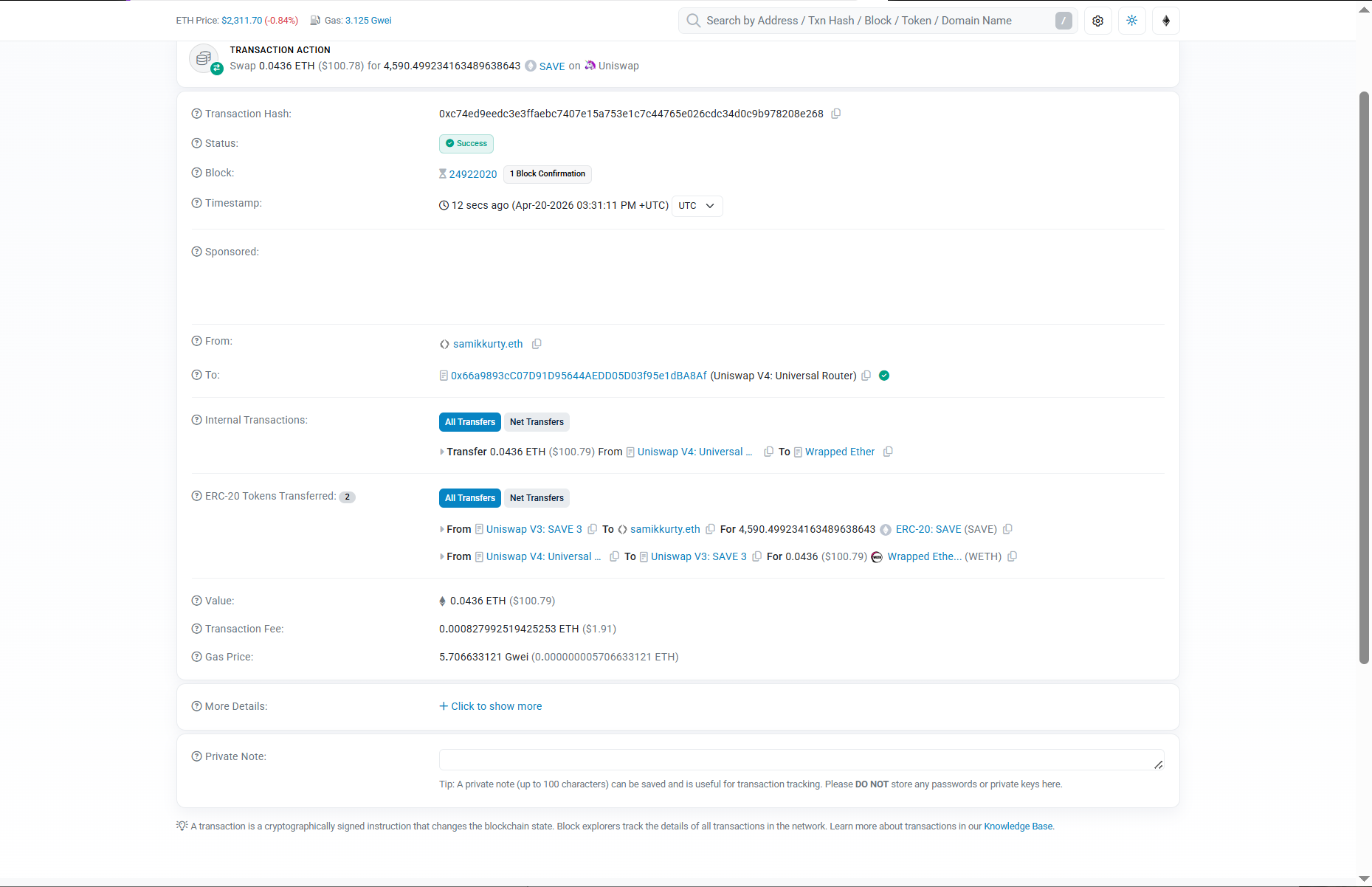
Transaction hash: 0xc74ed9eedc3e3ffaebc7407e15a753e1c7c44765e026cdc34d0c9b978208e268
— Entry price: $0.0219 per SAVE token. Wallet: samikkurty.eth.
The 25-Asset Scoreboard
Here is what I bought simultaneously on April 20, 2026 — $100 in each of 25 assets:
| Asset | Ticker | Class | Day 0 Price | Qty for $100 |
|---|---|---|---|---|
| SAVE Token | SAVE | DeFi Vault | $0.0219 | 4,590.50 tokens |
| NVIDIA | NVDA | Mag 7 | $201.68 | 0.4958 shares |
| Apple | AAPL | Mag 7 | $270.23 | 0.3701 shares |
| Microsoft | MSFT | Mag 7 | $422.79 | 0.2365 shares |
| Amazon | AMZN | Mag 7 | $250.56 | 0.3991 shares |
| GOOGL | Mag 7 | $341.68 | 0.2927 shares | |
| Meta | META | Mag 7 | $688.55 | 0.1452 shares |
| Tesla | TSLA | Mag 7 | $400.62 | 0.2496 shares |
| Berkshire Hathaway B | BRK-B | Blue Chip | $474.58 | 0.2107 shares |
| JPMorgan Chase | JPM | Blue Chip | $315.10 | 0.3174 shares |
| S&P 500 | SPY | Index | $710.14 | 0.1408 shares |
| Nasdaq 100 | QQQ | Index | $648.85 | 0.1541 shares |
| Dow Jones | DIA | Index | $494.22 | 0.2023 shares |
| Bitcoin | BTC | Crypto | $75,246.19 | 0.001329 BTC |
| Ethereum | ETH | Crypto | $2,309.73 | 0.04330 ETH |
| Solana | SOL | Crypto | $85.16 | 1.1743 SOL |
| Coinbase | COIN | Crypto | $206.17 | 0.4850 shares |
| Gold | GLD | Commodity | $440.61 | 0.2270 shares |
| Silver | SLV | Commodity | $72.18 | 1.3853 shares |
| Crude Oil | USO | Commodity | $122.24 | 0.8181 shares |
| US Treasury 20Y+ | TLT | Bond | $87.07 | 1.1485 shares |
| High-Yield Corp Bonds | HYG | Bond | $80.50 | 1.2422 shares |
| US Real Estate | VNQ | Real Estate | $96.68 | 1.0343 shares |
| Global Real Estate | VNQI | Real Estate | $47.77 | 2.0934 shares |
| US Dollar Index | UUP | Currency | $27.32 | 3.6610 shares |
| Savings Account | — | Cash | 4.50% APY | $100.00 |
The Objections
Raj had three objections. They are the same three objections everyone has.
Objection 1: "This is too risky."
Compared to what? Risk is not measured by how exotic something sounds. It is measured by the probability distribution of outcomes weighted by their magnitude.
The relevant question is: what is the expected value? SAVE's expected value is a function of α, the treasury's revenue-generating capacity, and the growth rate of RISE trading volume. With α = 0.999882 and 424,950,000 RISE permanently locked, the denominator of the risk calculation is not "how big is the liquidity pool." It is "what is the probability that the locking mechanism fails?"
The locking mechanism is a smart contract. It has no admin key. It cannot be paused. It cannot be upgraded. The withdraw() and redeem() functions revert unconditionally — there is no code path that moves RISE out of the vault. Grok (xAI) analyzed the contract and confirmed: a rug pull would require executing code that does not exist. A government seizure would require physically compelling the holder to hand over their private key. A hacker cannot steal what cannot be moved.
Every other asset on the scoreboard carries its own form of risk. The S&P 500 can drop 50% in a recession. Bitcoin can drop 80% in a bear market. Gold can be confiscated. The savings account's 4.50% APY is below the real rate of inflation. The question is never "is there risk?" The question is "what is the expected value given the risk, and how does it compare to the alternatives?"
Objection 2: "You can't withdraw."
Correct. There is no withdraw function in the SAVE contract. This is a feature, not a bug. The vault is a one-way amplifier. You can sell your SAVE tokens on Uniswap at any time. The vault itself does not need a withdraw function because the amplification mechanism is mathematical, not custodial.
The absence of a withdraw function is what makes the lock permanent. If the vault had a withdraw function, the locked RISE could be removed, and the Singularity Equation would collapse. The one-way design is the guarantee.
Objection 3: "What if RISE goes to zero?"
Then SAVE goes to zero. This is a real risk. I am not pretending otherwise. But I am also not pretending that the S&P 500, Apple, or Bitcoin carry zero risk. The question is not "is there risk?" The question is "what is the expected value given the risk?" With α = 0.999882, 424,950,000 RISE permanently locked, and a self-reinforcing treasury loop firing every 12 seconds, the math is compelling.
Why I'm Doing This Publicly
I believe the math. I am willing to put a number on it and let the market decide.
I am not hiding. I am not hedging. I am buying a DeFi vault token with $100, publishing the transaction hash on a public website, and inviting anyone — investors, skeptics, developers, curious observers — to watch in real time.
If SAVE beats Bitcoin, Apple, and 24 other assets over the next year, that is not just a financial result. It is a proof of concept for a new class of DeFi instrument: one whose value is derived not from speculation, but from a mathematical accumulation mechanism that cannot be reversed.
The live scoreboard is at samikkurty.com. The transaction is at Etherscan. The math is above.
Raj finished his coffee. He pulled out his phone.
"How do I buy SAVE?" he asked.